OUR GOALS

We aim to enrich academic programmes, competence and capacity of individuals in the field of law. By doing so, we seek to strengthen the Rule of law and justice institutions in Lao PDR.
LEGAL
EDUCATION

Transferring legal knowledge

LEGAL
RESEARCH

Building legal knowledge

ACCESS TO KNOWLEDGE

Disseminating legal knowledge

UPCOMING EVENTS

No Events
No Events
Mon
Tue
Wed
Thu
Fri
Sat
Sun
M
T
W
T
F
S
S
29
30
1
2
3
4
5
6
7
8
9
10
11
12
13
14
15
16
17
18
19
20
21
22
23
24
25
26
27
28
29
30
31
1
2

LATEST NEWS

Project supported by the Ministry of Foreign and European Affairs of the Grand Duchy of Luxembourg, Directorate for Development Cooperation and Humanitarian Action

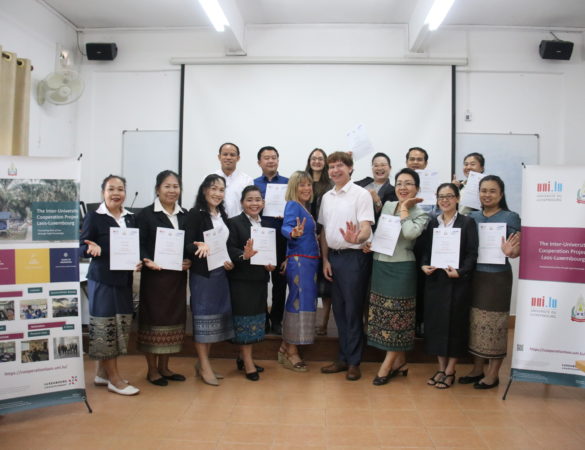
From June 14th to 19th, excluding the weekend, the Faculty of Law and Political Science in Vientiane hosted a workshop on Clinical Legal Education (CLE). The event, facilitated by Professor Elise Poillot from the University of Luxembourg and Mr. Fabrice Hénard, an international expert in higher education quality assurance and TTVET, and CEO of the International Network of Quality Assurance Agencies, aimed to enhance the CLE programme and the capacities of teachers involved in CLE at the FLP and to contribute to a platform for teachers’ exchange with professors from Luxembourg University.

Nineteen teachers from five departments, the FLP CLE, the Academic Division, and other teachers with a CLE background participated, sharing their knowledge and experiences. Professor Elise and Mr. Fabrice discussed CLE in Luxembourg and Europe, while FLP participants shared their insights on CLE at the FLP.
The discussions centered on setting appropriate standards for CLE programmes, comparing European standards with those at the FLP, and identifying beneficial standards for adoption. During the second day, participants shared their ideal set of standards for the legal clinic and discussed potential challenges in adopting and implementing these standards.

On the last day, seven participants from the FLP—Mr. Pangthong, Ms. Thasanalone, Mr. Intha, Ms. Duangmala, Mr. Phanthasack, Ms. Vilay, and Ms. Khampheiw—gave short presentations addressing the following questions: What were the most significant points raised during this seminar that will benefit your clinic? Among the topics covered, which would you have liked to explore in more depth (e.g., clinical program content, implementation of standards, etc.)? How do you envision the follow-up to this seminar in terms of collaboration between the Luxembourg clinic and your clinic?

Participants expressed a keen interest in further exploring topics like clinical program content and standards implementation. They also emphasized the importance of ongoing collaboration between the Luxembourg and Laos CLE programs.
Feedback highlights included positive remarks on the workshop’s content, noting that it would improve their work quality in CLE. The knowledge-sharing sessions were particularly useful, and participants expressed a desire for more workshops on Clinical Legal Education, believing that additional training would further enhance their skills and understanding of best practices in CLE.

The Inter-University Cooperation Project organized its 7th Summer Law School from 21st to 24th May 2024 in Vang Vieng, Laos. Eleven candidates from the Faculty of Law and Political Science (FLP), of the National University of Laos were invited for this intensive 4-day seminar based on their interest in improving their legal knowledge and their involvement with the Inter-University Cooperation Project.

The Summer Law School was dedicated to “the importance of sovereignty in the transformation of the Lao People’s Republic into a Constitutional State”. The Summer Law School was taught in English with contributions from Prof. Stefan Braum (Project leader, University of Luxembourg), Ms. Melina Anastasopoulou (PhD, University of Luxembourg), Ms. Isabella Lorenzoni, (PhD, University of Luxembourg), Ms. Zahra Yusifli (PhD, University of Luxembourg), Ms. Vialy Langkavong (FLP), Ms. Boualaphiane Sisouk (FLP), Mr. Pangthong Xayyavong (FLP and University of Luxembourg), Mr. Intha Douangphila (FLP), Dr. Lone Lindholt (SSA, LAO/037) and Ms. Paulina BASCHTON (Liaison Officer for the Inter-University Cooperation Project).

The first day of the Summer Law School, started with opening remarks by the project leader Prof. Braum and the Vice Dean of the FLP, Prof. Thatsanalone; and followed by an introductory session by Prof. Braum familiarizing the participants with “the matrix of sovereignty” a graph that was developed by Master students at the University of Luxembourg, together with Prof. Braum, to illustrate characteristics of sovereignty. Prof. Braum linked the theme of this year’s Summer Law School to the discussions from the 6th Winter Law School in December 2023, which addressed Laos’ sovereignty challenges arising from geopolitical factors. The introductory session created a common understanding of the notion of sovereignty. Participants actively discussed the “matrix of sovereignty” and tried to place Laos on the matrix.

On the second day of the Summer Law School, Ms. Melina Anastasopoulou gave a presentation on fundamental concepts of sovereignty. She covered both traditional and modern perspectives of sovereignty. Additionally, she explored the formation of nation-states and the internal and external aspects of sovereignty. Following this, Ms. Vilay Langkavong, a colleague from the National University of Laos, presented on ‘Sovereignty in the Laotian Constitution.’ Ms. Langkavong introduced the participants to the constitutional articles that define sovereignty.

In the afternoon Ms. Isabella Lorenzoni presented on the topic of sovereignty in the international legal order and the European Union. Participants discussed how international factors influence national sovereignty. In this context Prof. Braum recalled the challenges associated with the definition of the concept of proportionality in the Lao context; a concept, which has been discussed extensively during the last Summer Law School in June 2023. The day ended with a presentation by Ms. Boualaphiane Sisouk (FLP) discussing “Lao PDR in the context of ASEAN – what is the future for Lao sovereignty”.

Day 3 of the Summer Law School started with a discussion on ASEAN decision making mechanisms, its influence on Laos and sovereignty, relating to the presentation by Ms. Sisouk. This was followed by a presentation by Ms. Anastasopoulou on climate change and erosion of sovereignty leading to engaged discussions of environmental challenges in Laos. The following presentation was given by Ms. Zahra Yusifli on “Poverty Reduction and the Protection of Vulnerable People”. Ms. Yusifli highlighted the root causes of poverty and posed critical questions to our Lao colleagues about strategies to uplift the quality of life for concerned citizens. The session was highly interactive, with active participation from the Lao colleagues who shared their perspectives on how Laos can progress and overcome poverty.

In the afternoon Ms. Lorenzoni conducted a session on “sovereignty in times of digitalization and AI”. She familiarized the participants with the concepts of cyberspace and discussed the impact of Artificial Intelligence on sovereignty. Following Ms. Lorenzoni, our Lao colleague, Mr. Pangthong Xayyavong, gave a presentation on the “Challenges for Lao PDR and Legal Frameworks to Manage Global Risks”. He outlined the specific challenges that Laos faces and the critical role of lao legal framework in managing these global risks. The day ended with a presentation from Ms. Yusifli on State Sovereignty, Self-Determination, and Geopolitics. She addressed the jurisdictional limits of sovereignty in international law (international treaties, agreements, and conventions) and emphasized current events that exemplify the use of self-defense claims to protect sovereignty under Article 51 of the UN Charter.

On the last day of the Summer Law School, Mr. Intha Douangphila delivered an insightful presentation on the sovereignty of Laos in its external relations with countries in Asia and Europe. He discussed how Laos engages in cooperation and external relations. The seminar concluded with a round-table discussion, where all participants were invited to reflect on the lessons and points discussed over the four-day seminar.

All participants showed enthusiasm and motivation during the event and energetically interacted with the guest speakers and each other. They gained an understanding of the significance of the concept of sovereignty in a rule of law state.

Congratulations to the Lao team participating in the 22nd Red Cross International Humanitarian Law (IHL) Moot Court 2024 in Hong Kong. The international competition of the acclaimed IHL Moot Court took place between 6 – 9th March 2024 in Hong Kong. The competition hosted 22 teams of law students from different universities across the Asia-Pacific Region. The Inter-University Cooperation Project has been actively supporting the participation of students from the Faculty of Law and Political Science, Vientiane (FLP) in this international competition since 2018. For this year, the team of students from the FLP was coached and supported in participating at the International moot court competition by Dr. Perrine Simon (coach) and Ms. Paulina Baschton (Liaison Officer of the project).

The Lao team has been trained intensively until the last day of the competition after winning the National Round in December 2023. They worked extremely hard and put a lot of effort into this highly competitive moot court. Although the team from the National University of Laos did not advance to the quarterfinals, the team garnered positive feedback from judges, showcasing their oral pleading skills. Moreover, the team received a good scoring in the written memorials with an average of good-good+. It is also notable that the Lao team met the team from the Philippines (the team that later won the overall competition) in the very first round and did a very good job pleading against such a strong team. 

After four days of competition, with a total of 22 teams of law students from across the Asia-Pacific region, the University of San Agustin (Team from the Philippines) won the competition. The first runner-up was awarded to Thammasat University. Ms. Samantha Grajo from the University of San Agustin was awarded the Best Mooter of the Final Round. Tribhuvan University received the award for the best prosecution memorial, while the University of Adelaide was honored with the best defense memorial. For more details on the 22nd IHL Moot Court competition results and announcement, follow the official link here: https://www.redcross.org.hk/en/moot22/results.html

This year’s moot problem presented a complex scenario revolving around a conflict between traditional religious values and economic development. It involved allegations against a religious leader for crimes against humanity and war crimes, including the purchase and use of drones and cluster munitions resulting in civilian harm, as well as the recruitment of minors for hostilities. The problem addressed contemporary issues such as the use of drones and cluster munitions in warfare.

During the days of the event, students had the opportunity to attend the Keynote Seminar on “Urban Warfare and the Relevance of IHL in Preventing and Reducing Civilian Harm”. The panel discussion of this Keynote Seminar was led by Ms. Marwa Shabbar (Head of Legal Department, Regional Delegation for East Asia, The International Committee of the Red Cross) and Dr. James Fry (Associate Professor of Faculty of Law, The University of Hong Kong). At the end of the session, participants had a chance to raise their question and to discuss with the panelists.

This Moot court organised by the ICRC is a great way to stimulate legal thinking, by learning how to develop legal arguments appropriately. Students also have improved their critical thinking and problem-solving skills, analyzing skill, presentation skills, debating skills and also their English language skills!
We are very proud of the Lao team of 2024!

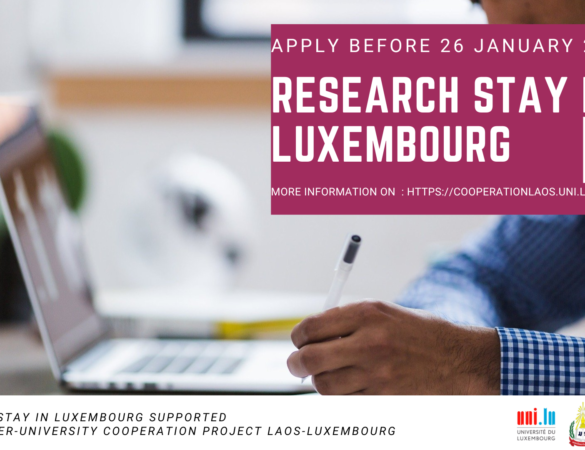
The University of Luxembourg is proud to announce the opening of applications to grant two candidates for a legal research stay in Luxembourg, which will take place in May-June or October-November 2024.

The Faculty of Law, Economics, and Finance (FDEF) of the University of Luxembourg will provide a friendly international environment in which the selected researchers can gain experience in research methodology, in presenting their research, attending seminars, and develop contacts with Professors of the faculty and other researchers. The research stay aims to enable candidates to finalise and publish an article or a research paper written in English in a law journal.

Criteria

The research stay programme is dedicated to Lao lecturers who desire to gain experience in an international environment to improve their academic and research skills in the legal field, in order to strengthen the capacities of the Faculty of Law and Political Science of the National University of Laos. Applicants must be lecturers at the Faculty of Law and Political Science of NUOL, with at least a Bachelor’s degree in law or with a strong component in law. There are no criteria in terms of age. Candidates will be selected based on merit. The University of Luxembourg will have full discretion in selecting and/or rejecting the applications.

Supervision

The Project will provide thorough research guidance before and during the research stay program. The selected candidates will be supported to carry out their research and be supervised by the Project’s Liaison Officer and Project leader during their stay.

Selected candidates will be required to participate fully in capacity-building activities organised by the Inter-University Cooperation (seminars, research workshops, etc.) also University of Luxembourg. They will be committed to presenting and publishing their research papers in English in a law journal within the designed time.

Selected candidates shall ensure that their research complies with the University of Luxembourg procedures, in particular on research ethics and plagiarism

Administration

The project will facilitate the successful candidate with Visa and Housing applications. All expenses (travel, accommodation and per diem) will be covered.

The candidates will be entirely responsible for the management of the funding allocated; no extra-costs will be borne by the Project.

Application

The application must be written in English and should encompass:

– A CV with full contact details;

– A motivation letter;

– A description of the research subject and methodology (maximum 500 words).

Application deadline: 26 January 2024.

The pre-selected teachers will be invited for an interview at the FLP.

Applications must be sent to the Liaison officer and Project Assistant:

Liaison Officer, Paulina Baschton: Paulina.baschton@ext.uni.lu

Project Assistant: Patthanaphone Nammalath: patthanaphone.nammalath@ext.uni.lu

We are looking forward to your papers and to welcoming you in Luxembourg!

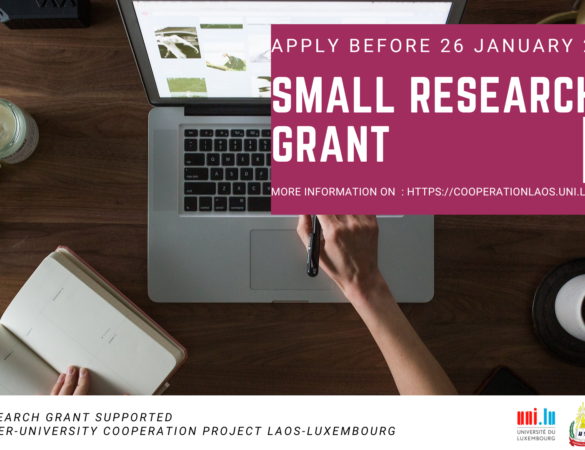
The University of Luxembourg is proud to announce the opening of applications to select academic staff to undertake research in the field of law from the Faculty of Law and Political Science of the National University of Laos to pursue a research project under the supervision of the Inter-University Cooperation Project Laos-Luxembourg.

Criteria

The research programme is dedicated to Lao lecturers to improve their academic and research skills in the legal field, in order to strengthen their research capacities and the capacities of the Faculty of Law and Political Science of the National University of Laos. Applicants must be lecturers at the Faculty of Law and Political Science of NUOL, with at least a Bachelor degree in law or with a strong component in law. There are no criteria in terms of age. Candidates will be selected based on merit. The University of Luxembourg will have full discretion in the selection and or rejection of the applications.

In line with the “Luxembourg General Cooperation Strategy for Sustainable Development – Road to 2030”, the Inter-University Project welcomes research proposals falling under the following themes:

  • Rule of law and governance;
  • Fundamental rights;
  • Gender equality;
  • Environment sustainability and climate protection. 

Supervision

The Project will provide thorough research guidance during the grant period. The selected candidates will be supported to carry out their research and be supervised by the Project through regular meetings to share the progress of their research.

Selected candidates will be required to participate fully in capacity building activities organised by the Inter-University Cooperation (seminars, research workshops, etc) and will be asked to present their research to the public. They will also have to submit progress reports every 3 months, in accordance with the research contract signed with the University of Luxembourg.

Administration

Selected candidates will receive a grant equivalent to 1 200 EUR to complete their research.

The scholarship will be granted by Uni.lu to the lecturer in 4 instalments. Payment of the Uni.lu’ scholarship is based on merit and will be conditional on compliance with the obligations of the researcher set up in the “scholarship agreement” including in particular the submission of advancement reports every 3 months to the Liaison Officer of Inter-University Cooperation Project in Vientiane.

The candidates will be entirely responsible for the management of the funding allocated; no extra-costs will be borne by the Project.

The candidates will conduct their research from Lao PDR.

Selected candidates shall ensure that their research complies with the University of Luxembourg procedures, in particular on research ethics and plagiarism and  the guideline on Legal Research Methodologies.

The research will take the form of a paper written in English(Preferred) or Lao. The length of the final paper will be discussed with the Liaison Officer. The research must be completed within one year from the date of signing the grant contract, and the agreed research outcome submitted.

Applicants can only apply for a funding grant as an individual researcher, not as a team or institution.

Application

The preferable language for the application is English, but it can also be written in Lao and should encompass:

– A cover letter (not to exceed 2 pages);

– A curriculum vitae with full contact details including academic experience (courses taught, previous research experience, university curriculum, etc);

– A research proposal (not to exceed 3 pages including the bibliography) the research proposal should include a description of the research topic (introduction), the hypothesis, research objectives and envisaged methodology as well as a short bibliography (15 references maximum).  

Application deadline:  26 January 2024

The pre-selected candidates will be invited for an interview.

Applications should be submitted to Paulina Baschton: paulina.baschton@ext.uni.lu   and to Patthanaphone Nammalat: patthanaphone.nammalath@ext.uni.lu

Call for application can be downloaded Here

You can look into our MOOC on Legal Research Methodology to effectively get started to design and conduct good legal research.

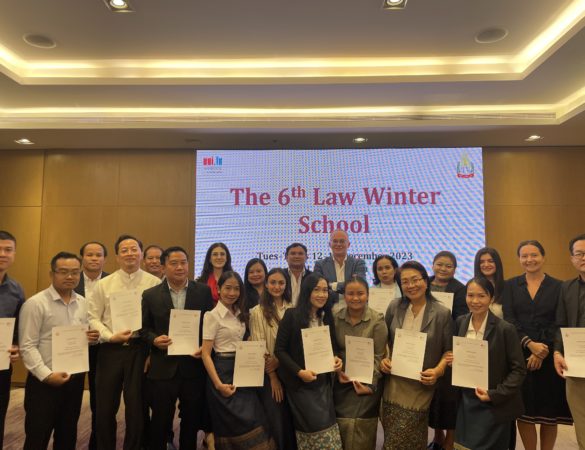
The Inter-University Cooperation Project organized its 6th Law Winter School from December 12th to 14th, 2023, at the Crown Plaza, Vientiane Capital, Laos. Twenty candidates were invited based on their interest in improving their legal knowledge for an intensive 3-day seminar. The 6th Law Winter School included Fourteen law lecturers from the Faculty of Law and Political Science, two lecturers from National Institute of Justice and four practitioners (two judges and two prosecutors).

The Law Winter School was dedicated to the subject of “the Role of Transparency in a Rule of Law State”. The Winter School dealt with the interdependence between good governance and rule of law in relation to the principle of publicity and access to justice, the protection of Transparency by the 3 main branches of the state and good practices of good governance in relation to the international anti-corruption framework. This Winter School was taught in English by Prof. Stefan Braum (University of Luxembourg), Laura AADE (PhD, Uni.lu), Francesca FINELLI, (PhD, Uni.lu), Anna MACHURA (PhD, Uni. lu) and Paulina BASCHTON (Liaison Officer of the Inter-University Cooperation Project in Laos).

Prior to the winter school participants followed a 1 day research methodology seminar to equip the them with relevant legal research skills which could be helpful for their research. Participants learned from examples and experiences from the PhD’s from the University of Luxembourg how to state research problems, find suitable research questions, how to find and use relevant databases, and methods of citation. During the presentations, the participants raised a lot of questions regarding their own research and discussed legal issue in Laos in related to the PhD’s field of expertise.

The first day of the Law winter school, started with opening remarks by the project leader Prof. Stefan Braum and the Dean of the FLP, Assoc. Prof. Viengvilay Thiengchanhxay. The topics presented and discussed during the winter law school centred around the topic of “Interdependences between Good Governance and Rule of law Principles”. On the first day the presentations were the dedicated to the principle of publicity presented by Laura Aade, a presentation by Francesca Finelli on the principle to access to justice and a presentation by Anna Machura-Urbaniak on the “protection of transparency by means of law enforcement by the executive branch”. Participants actively discussed the definition of transparency, the limits of transparency in the context of access to justice, the practices in Laos, and the importance of balancing transparency and privacy.  

Day 2 of the Law winter law school was dedicated to the principles of transparency for the Judiciary and Legislative branch presented by Francesca Finelli and Laura Aade. The participants were assigned hypothetical cases involving the application of the principle of transparency, many scenarios were given by the PhD to equip participants with concrete examples. Prof. Braum showed the participants a matrix for transparency principles for participants to deepen their understanding and to understand the application of these principles for each state actor.

Day 3 was dedicated to “good practice and good government in anti-corruption framework” presented by Anna Machura-Urbaniak. Participants held lively discussions with regards to corruption issues on a global and national scale, they also discussed how they, as legal academics and practitioners, can address this sensitive yet complex topic and help Laos in its move toward a rule of law state. The discussions involved identifying mechanisms used in Luxembourg and sharing experiences in relation to the progress the Lao government has already made in this regard. This Law Winter School ended with a round-table reflection, which allowed participants to discuss how to enhance the teaching and research of the principles of transparency.

All participants showed enthusiasm and motivation during the event and energetically interacted with the guest speakers and each other. Participants learned to understand the importance of transparency in a rule of law state. All participants were provided with learning materials to support and strengthen their knowledge.