OUR GOALS
We aim to enrich academic programmes, competence and capacity of individuals in the field of law. By doing so, we seek to strengthen the Rule of law and justice institutions in Lao PDR.
Project supported by the Ministry of Foreign and European Affairs of the Grand Duchy of Luxembourg, Directorate for Development Cooperation and Humanitarian Action

On the 14th of December 2022, the Lao National round of the ICRC International Humanitarian Law Moot Court competition took place at the Faculty of Law and Political Science (FLP) with the assistance of the University of Luxembourg.
This year, three teams, representing in turn the Defence and the Prosecution, competed against each other. As usual, the fictitious case on which teams were pleading in English was set before the International Criminal Court (ICC). Judges for this year’s national round of the competition included Dr. Papawadee Tanodomdej (Lecturer at Chulalongkorn University), Ms. Sophia Cason from The Asia Foundation (Chief of Party, Laos Legal Aid Support Program) and Mr. Phanthasak Mingnakone (Lecturer at Faculty of Law and Political Science, NUOL).

Exceptionally this year, the competition was organised and financially supported by the University of Luxembourg due to the ICRC’s shortage of staff. All the mooters were trained by Dr. Perrine Simon, Liaison Officer of the University of Luxembourg based in Vientiane, and Dr. Lawrence Siry who gave them a week-long intensive physical course on Mooting in October 2022. These were the first Students’ Moot Court training face-to-face after the pandemic and it is hoped that more teams will participate next year in order to keep supporting this significant Asia-Pacific competition.


This IHL Moot court is a great way to stimulate legal thinking, by applying legal reasoning and learning how to develop arguments appropriately. Students also improved their presentation skills, debating skills and English! After years of virtual pleadings, the winning team is going to Hong-Kong in March 2023.
Congratulations to all teams, especially the winning team Mr. Amphon Khammanyvong, Ms. Latdaphone Sorphapmexay, and Ms. Soumaly Sisouthammamnouny, which will be representing the FLP in the International Round of the competition in Hong-Kong!


Under the framework of the Inter-University Cooperation Project Laos-Luxembourg, the development of the library at the Faculty of Law and Political Science (FLP) of NUOL is given priority along with the research aspect.
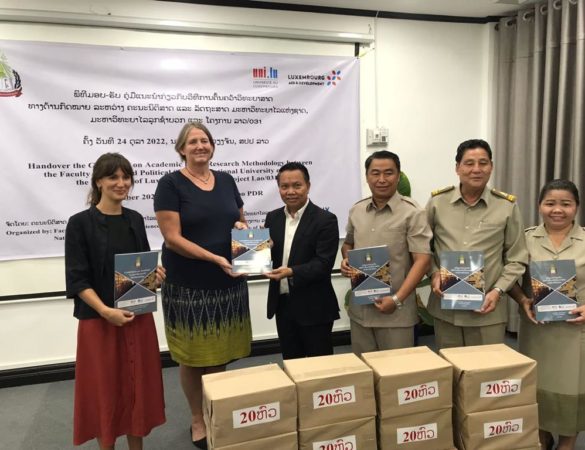
On 9th of December, a ceremony for the handover of “Guidelines on Academic Legal Research Methodology” was organised at the Faculty of Law and Political Science (FLP). The ceremony was attended by Assoc. Prof. Viengvilay Thiengchanxay (the Dean of the FLP), Dr. Somdeth Keovongsak, Mr. Bonkhong Phetdaohong, Mrs.Thatsanalone Sisunon (Vice Deans of the FLP), Dr. Lone Lindholt (CTA of LAO/031) and Dr. Perrine Simon (the Project’s Liaison Officer), along with other FLP lecturers. In total over 1000 printed copies have been handed over, in Lao and English, to the FLP, National University of Laos.

The “Guidelines on Academic Legal Research Methodology”, were drafted together by lecturers from FLP with the academic support of the University of Luxembourg and its Liaison Officer Dr. Perrine Simon in the framework of the Inter-University Cooperation Project Laos-Luxembourg and with the financial support of the LuxDev Project LAO/031.
The aim of developing and acquiring the guidelines is to provide the FLP lecturers and students with a comprehensive guide to conduct legal research. This marks a significant step in improving research skills and strengthening students’ and teachers’ legal higher education.

Would you like to have guidelines on Legal Research Methodologies? Click here
Since 2017, the University of Luxembourg, through its Faculty of Law, Economics and Finance is actively promoting the Rule of law through legal knowledge in the framework of an Inter-University Cooperation Project (2017-2021) signed in 2015 between the Grand Duchy of Luxembourg and Lao People’s Democratic Republic.
This project is a bilateral cooperation funded by the Luxembourg Ministry of Foreign and European Affairs, Directorate for Development Cooperation and Humanitarian Affairs. It provides assistance in the field of legal higher education to the National University of Laos (NUoL), specifically the Faculty of Law and Political Science. The Inter-University Cooperation Project seeks to foster a genuine legal culture and reinforce best practices for law students, lecturers and researchers at the Law Faculty in Vientiane. To learn more about what we do, see: https://cooperationlaos.uni.lu/.
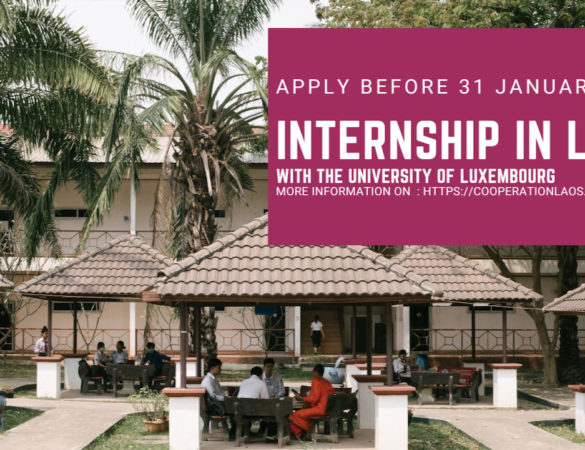
We are looking for enthusiastic students – up to two – from the FDEF to intern with our Project for a two-months period. We will provide the intern with a friendly and dynamic working environment with a hands-on experience of a development cooperation project.
The intern will be assisting with the organisation of capacity building activities, act as mentor for Laotians students and will conduct research on a topic related to Lao law. The Intern will work under the supervision of the Liaison Officer at the office of the Inter-University Project at the Faculty of Law and Political Science-NUoL in Vientiane Capital.
The selected intern will be receiving a stipend of €700/month plus a travel allowance of 1500 EUR.
Criteria
Applicants must be enrolled at FDEF in a law degree. They must be either in the final year of their bachelor or in year 1 or 2 of Master.
Candidates should demonstrate interest in Rule of law development and display cultural sensitivity. They should have a strong track record of legal research and academic writing skills and knowledge of fundamental rights.
Application
Applications must be written in English and should encompass:
– A CV with full contact details;
– A motivation letter.
Application Deadline: 31st of January 2023
Selected candidates will be contacted an interview.
Applications must be sent to:
Prof. Stefan Braum stefan.braum@uni.lu
Ms. Paulina Baschton paulina.baschton@ext.uni.lu
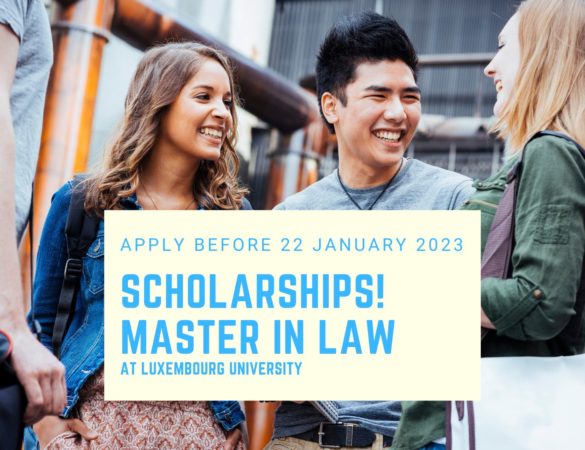
Under the framework of the Inter-University Cooperation project between the Grand Duchy of Luxembourg and Lao People’s Democratic Republic, the University of Luxembourg and the National University of Laos are proud to announce the opening for applications to join our Master programme in Law during one year at the University of Luxembourg. The scholarship is open to graduates from the Faculty of Law and Political Science of the National University of Laos.
Year one – Master in Law at the University of Luxembourg
The University of Luxembourg offers six outstanding LL.M. specialisations including “European Union law and its litigation system”, “European Economic and Financial Criminal Law” and more. For more information, see:
https://wwwen.uni.lu/studies/fdef/ll_m_programmes/ll_m_programmes2.
The Master of Laws (LL.M. degree) provides opportunities for Law students to advance their specialisation and career in Law. All LL.M. programmes at the University of Luxembourg are oriented towards European law, with a common first year and a highly specialised second year.
The first year (M1) at the University of Luxembourg explores all six specialisations offered in the second year. It includes for example advanced classes on Institutional and Substantive EU law, International and transnational context, on International and European human rights protection. For more information, see: https://wwwen.uni.lu/studies/fdef/ll_m_programmes/ll_m_programmes2.
Why study for a Master at the University of Luxembourg?
The University of Luxembourg offers a unique multilingual and multicultural approach, reflected in the international student body and faculty. All masters programmes are taught in English (and French), with opportunities for students to acquire professional language skills and a competitive advantage in a globalised working environment.
Small class sizes ensure practical and personalised teaching by distinguished academic staff of the Research Unit in Law, supported by judges, legal practitioners and other professionals from the field.
Students can take part in international moot court competitions to gain practical experience and recognition. Clinical teaching is integrated into some of the programmes.
Our scholarship
We are happy to offer a grant covering all expenses (travel, accommodation and per diem) to study for one year in the Master in Law programme at the Faculty of Law, Economics and Finance (FDEF) of the University of Luxembourg. The costs will be entirely supported by Inter-University Cooperation Project Laos-Luxembourg.
Our University will provide you a friendly and dynamic international academic environment at the heart of the Europe.
If the selected candidate is successful with the year one of the Master in Law, he/she will be able to apply for another one-year scholarship for the second year of the programme (M2).
Criteria
We are looking for enthusiastic graduates (or graduating this academic year) from the Faculty of Law and Political Science of the National University of Laos.
Applicants must at least hold a bachelor law degree or with a strong component in law. Candidates should seek to pursue their career in law, for example through teaching or practice in the future.
There are no criteria in terms of age. Candidates will be selected based on merit.
Criteria will be in particular the excellency of their grades, interest for studying law, the quality of their application and their level of English proficiency (B2 recommended). French is an asset.
The University of Luxembourg will have full discretion in the selection and or rejection of the applications.
Application
Applications must be written in English and should encompass:
– A CV with full contact details;
– A motivation letter.
Selected candidates will be contacted for a written test (short essay on a research topic) and if successful an interview in February 2023.
Applications must be sent to:
Ms. Paulina Baschton paulina.baschton@ext.uni.lu
and Mr. Patthanaphone Nammalath patthanaphone.nammalath@ext.uni.lu
Download our call for application: https://dropit.uni.lu/invitations?share=d680bbea1f895b7a02fe&dl=0
Under the framework of the Inter-University Project Laos-Luxembourg, the University of Luxembourg is supporting students’ training for the ICRC IHL Moot Court Competition since 2016.
A one-week Moot Court training was organized from 24th to 28th October 2022 at the Faculty of Law and Political Science of NUOL. After a long period of restrictions due to Covid-19, participants could attend the event face-to-face.
Dr. Lawrence Siry, who has been involved in the moot training for the past three years, gave a one-week intensive training to a group of 10-15 FLP students to prepare them for the Lao National Round of ICRC IHL Moot coming next 14th of December. The training focused on how to make convincing pleadings and critically present arguments. Students also learned more deeply about International humanitarian law and International criminal law, as well as its application to the Moot problem of this year relating to environmental damages.
The first day of the training was dedicated to the participants’ self-Introduction and an introduction of a brief history of the International Criminal Court (ICC) and the International Committee of the Red Cross (ICRC).

On the Second day, the training was devoted to teaching about the legal process of the ICC or how the ICC handles each different case.
On the third day, the training focused on how the participants could find evidence or references to support their legal argument, including the Rome Statute of the International Criminal Court, the Charter of the United Nations, the Geneva Conventions and their Additional Protocols.

The fourth day of the training was dedicated to analyzing the Moot Problem, where participants had to work in groups and design their legal arguments in preparation of their memorials.
On the last day of the training, all the participants had the opportunity to show their pleading skills by using all the lessons they had learned in the past four days, and everyone could also make progress!

Moot court competitions are an essential aspect of “Problem-based learning” and promote practice-relevant teaching. Students will not only develop their legal skills but also enhance their speaking and debating skills, as well as their English skills. All students received certificates after completion of the training.

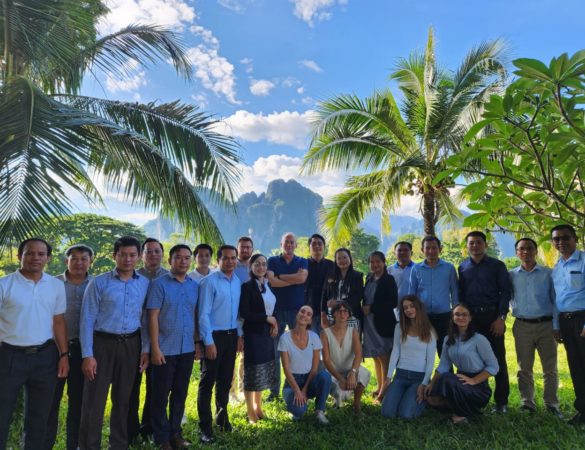
The Inter-University Cooperation Project organised its 4th Law Winter School from October 18th to 21th 2022 in Vang Vieng. Sixteen candidates were selected based on their interest in improving their legal knowledge for an intensive 3-day seminar. This edition included thirteen law lecturers from the Faculty of Law and Political Science and three practitioners (one former judge, one prosecutor, and one legal officer).
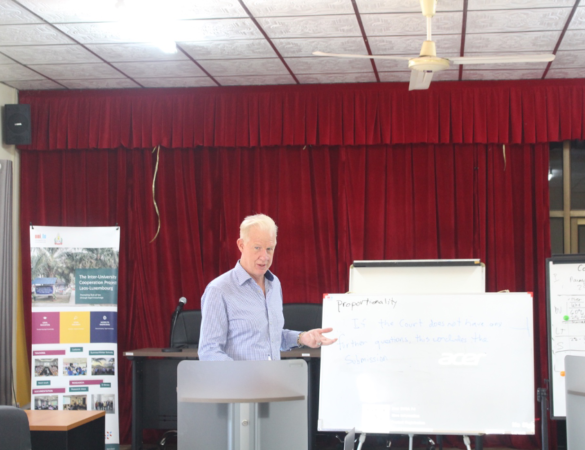
The Law Winter School was dedicated to “Rule of Law Principles,” particularly the principle of legality, which is highly relevant for interpreting and implementing laws. The Winter School also dealt with the legal principles of proportionality, fair trial and the right to property. This Winter School was taught in English by Prof. Stefan Braum (University of Luxembourg) and Andrii HUBAI (PhD, Uni.lu), Melina ANASTASOPOULOU, (PhD, Uni.lu), Anna MORAITI (PhD, Uni. lu) and Dr. Perrine Simon (Liaison Officer of University of Luxembourg in Laos).
This Law Winter School aims to provide participants with both theoretical and practical knowledge, as well create a dialogue on Rule of law principles among participants. Each session included practical exercises connecting the theory with hypothetical legal problems. Selected lecturers also presented their understanding of Rule of law principles such as legality and proportionality in the Lao context, while other presented their research projects connected to the fundamental right to property.


Day 1 of the Winter School started by defining the role and function of legal principles with a presentation from Pr. Braum, and then identifying which legal principles Rule of law implies with a presentation from Andrii Hubai. Participants actively discussed the difference between “Law” and “principles” as well as “Rule of law” and “Rule by law.” In the afternoon, the focus was on the principle of legality with a lecture followed by an exercise on legal interpretation with hypothetical legal problems.
Day 2 was dedicated to the principles of fair trial and presumption of innocence (presentation by Melina Anastasopoulou) as well as the principle of proportionality (presentation by Anna Moraiti). Ass. Prof. Viengvilay Thiengchanhxay, the Dean of the FLP also joined the sessions opening discussions on law drafting.


In the afternoon, participants had to work and plead on a hypothetical case involving the application of Rule of Law principles. They were divided into three groups – judge, prosecutor, and defendant – to perform pleadings. These small moot exercises where concluded by Prof. Stefan Braum’s feedback on how to enhance the correct application of Rule of law principles in solving concrete cases.


Day 3 was dedicated to the fundamental right to property, starting with a presentation from Andrii Hubai. Participants then discussed in groups small hypotheticals involving violations of the right to property. Lathdavanh and Khamphiew then presented their research topic on compensation issues in Laos and the property of spouses insisting on the relevance of the right to property in their topic. This Law Winter School ended with a round-table reflection, which allowed participants to discuss how to enhance the teaching and research of Rule of law principles.
All participants showed enthusiasm and motivation during the event and energetically interacted with the guest speaker and each other. They learned to understand the importance of the rule of law principles. All participants were provided a reading list to go further with learning support materials to strengthen their knowledge.
For the next Law Summer School, it is foreseen to deepen discussions on the principle of legality by focusing on legal certainty, interpretation and law drafting.