OUR GOALS

We aim to enrich academic programmes, competence and capacity of individuals in the field of law. By doing so, we seek to strengthen the Rule of law and justice institutions in Lao PDR.
LEGAL
EDUCATION

Transferring legal knowledge

LEGAL
RESEARCH

Building legal knowledge

ACCESS TO KNOWLEDGE

Disseminating legal knowledge

UPCOMING EVENTS

No Events
No Events
Mon
Tue
Wed
Thu
Fri
Sat
Sun
M
T
W
T
F
S
S
28
29
30
31
1
2
3
4
5
6
7
8
9
10
11
12
13
14
15
16
17
18
19
20
21
22
23
24
25
26
27
28
29
30
1

LATEST NEWS

Project supported by the Ministry of Foreign and European Affairs of the Grand Duchy of Luxembourg, Directorate for Development Cooperation and Humanitarian Action

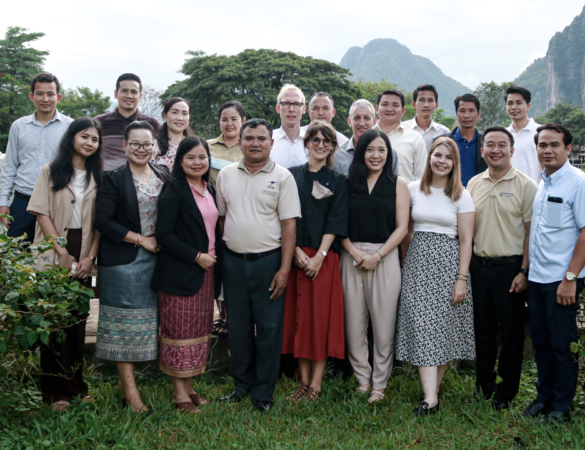
The Inter-University Cooperation Project organised its 3rd Law Summer School from May 18-to 20th 2022 in Vang Vieng. Seventeen candidates were selected based on their interest in improving their legal knowledge and English skills for an intensive 3-day seminar. This edition included 11 law lecturers from the Faculty of Law and Political Science, two law lecturers from the Faculty of Law and Administrative, Champassak University, and four practitioners (two judges and two lawyers). The participation of the two lecturers from the Faculty of Law and Administrative of Champassak University was made possible with the financial support of the LuxDev Project LAO/031.

The Law Summer School was dedicated to “Rule of Law Principles”, in particular to the principle of Legality, which is extremely relevant for the application of the law. We focused on Legal Certainty (“Lex  Certa“), meaning that the law must be precise and certain, and on the interpretation of the law. We were pleased to welcome Dr. Lasse Schuldt, Assistant Professor at Thammasat University in Bangkok, Thailand, specialised in Criminal law.

This Law Summer School aims to provide participants with both theoretical and practical knowledge. Each session included practical exercises connecting the theory with hypothetical legal problems.

Day 1 of the Summer School was dedicated to defining the scope of this universal principle and its international (ICCPR, art. 15) and domestic sources (art. 4 of the Lao Penal Code). Participants looked in particular at standards for legal clarity and the need to find a balance between flexibility and reliability of legal provisions. During group exercises, participants had to identify and evaluate indeterminate and unclear legal terms in existing selected Lao provisions of the Penal Code. They actively discussed whether vague terms could be understood through specific methods of interpretation or whether they were simply too vague and should be clarified/amended by the legislator.

Day 2 was dedicated to Lex Certa in the application of law. Participants learned about interpretation techniques. In the afternoon, the participants were divided into four groups to solve hypothetical legal problems provided by the instructors. The restitution was done in the form of role play involving pleading and as the prosecutor or the defendant.

            Day 3 was dedicated to Lex Certa in law-making. Participants looked at what makes good legislation in relation to legal certainty. In the afternoon, participants were asked to draft a “Fake News” offence.

All participants showed enthusiasm and motivation during the event and they energetically interacted with the guest speaker and with each other. They learned to understand the importance of respecting the principle of legality in all branches of law. All participants were provided a reading list to go further with learning support material such as explanatory textbook chapters, reference to Thai case-law, abstracts of different Southeast Asian Penal Codes to strengthen their knowledge.

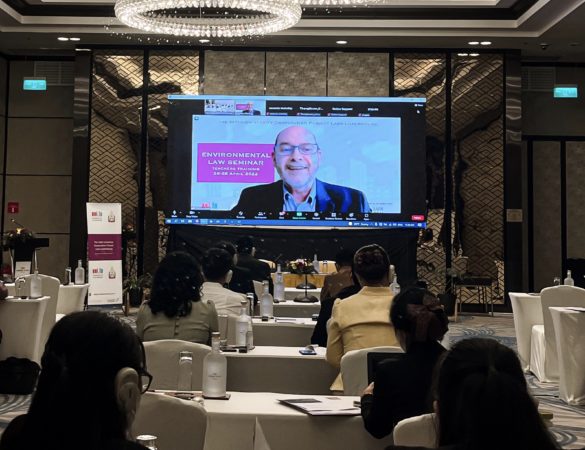
In the framework of the Inter-University Cooperation Project, the University of Luxembourg is supporting the teaching Environmental Law in Lao PDR, an academic course essential for sustainable development and climate protection. A 3-day seminar on Environmental Law was organised on April 26-28 2022 in Vientiane in a hybrid format. For the first time this year, after a long period of restrictions due to Covid-19, participants could attend the event face-to-face, whereas the main speaker delivered the seminar via Zoom.  The seminar focused on substantive law and teaching skills in Environmental Law to strengthen the skills of environment law lecturers from the Faculty of Law and Political Science, National University of Laos, the Faculty of Law and Administrative, Champassak University, and also National Institute of Justice.

This Environmental Law seminar was organised in collaboration with Mr. Matthew Baird, Director of the Asian Research Institute on Environmental Law (ARIEL) and coordinated by Dr. Perrine Simon (Uni.lu’s Liaison Officer). Matthew Baird is a lawyer specialised in the area of Environmental Law and an extensive experience in lecturers’ training in South East Asia having assisted ADB in developing a “Train the Trainers programme” for capacity development for Environmental Law academics in Asia, running in Cambodia, Thailand, Myanmar, and the Philippines.

Morning sessions were dedicated mostly to lectures, whereas afternoon sessions included group activities and discussions.  Participants were provided with a syllabus including references for learning and teaching Environmental Law such as online courses, handouts, templates of syllabus, and were also granted access to a folder including essential electronic resources.  

The first day of our seminar was dedicated to Introduction to Environmental Law and International Environmental Law and dealt with core environmental principles and international instruments, covering both hard and soft law.

In the afternoon, we welcomed via Zoom Dr David J. Devlaeminck, lecturer at the School of Law, Chongquing for an Introduction to Water Law, focusing specifically on the Watercourses Convention and the Mekong River basin. Then, Prof.  Amanda Kennedy (Faculty of Law, Queensland University of Technology, and Co-chair of the IUNC AEL Teaching Committee), gave a presentation on “Teaching Environmental Law with Pedagogy and Practice”. The participants were introduced to different learning theories and to the Bloom’s Taxonomy, dealing with learning outcomes, assessment methods, and learning activities.

The second day of the seminar was devoted to teaching Environmental Impact Assessment (EIA) and Comparative Environmental Law; teaching Climate Change Law and Litigation; and International Environmental Law with Matthew Baird. Dr. Perrine Simon led group discussions on curriculum design in the afternoon, where participants had to work in groups and choose one topic related to Environmental Law, such as Climate Change, International Legal Regime, International Environmental Law, and Natural Resources Law, and design their own curriculum on environmental law, including the content, learning objectives, and lesson plan. The other discussion topic was on pedagogy, where participants had to look back at their lesson plan and propose the learning activities or exercises to run with the students.

On the last day of the seminar, we had the chance to welcome Associate Prof. Jonathan Liljeblad from the Australian National University via Zoom to discuss designing Environmental Law curriculum. Participants also experienced blended learning and asynchronous teaching by watching a recorded lecture on “Human Rights and the Environment” prepared by Ass. Pr. Liljeblad. The final session with Mr. Baird dealt with resolving environmental disputes (environmental courts), environmental crime, and environmental justice. In the afternoon, we had a group discussion on reflective practice with Dr. Perrine Simon. Lecturers highlighted as their main challenges the lack of resources and of teaching tools, together with difficulties in communicating and transferring knowledge to students. They praised the access to teaching material and learning about pedagogy acquired during this 3-day event.

The participation of the lecturers of the Faculty of Law and Administrative of Champassak University and of the National Institute of Justice was made possible with the financial support of the LuxDev Project LAO/031.

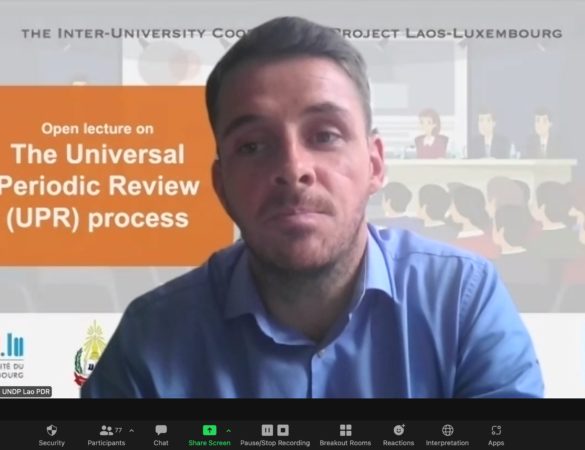
In the framework of the Inter-University Cooperation Project Lao-Luxembourg, the University of Luxembourg organised a special online lecture on the Universal Periodic Review Process (UPR) on the 11th of May  2022. We had the pleasure of welcoming Mr. Seán O’Connell, the Head of Governance of the United Nation Development Programme in Lao PDR (UNDP Lao PDR). Previously Seán was the Human Rights and Rule of Law Officer with UNDP Viet Nam, working on international human rights reporting mechanisms and business and human rights.

The speaker introduced the participants to the Universal Periodic Review (UPR) process. The Universal Periodic Review (UPR) is undertaken by the UN Human Rights Council and involves a periodic review of the human rights records of all 193 UN Member States. It allows States to assess each other and report what actions they have done to improve the human rights situation in their country (see for more details: https://www.ohchr.org/en/hr-bodies/upr/basic-facts).

Mr. O’Connell explained the three steps of the review process. There is first a “pre-review”, based on information provided by the State under review (national report), on UN reports and on information from other UN members institutions and civil society. The second step is the review which consists in an interactive discussion between the State under review and other UN Member States, where recommendations can either be accepted or noted. The third step is the post-review where monitoring of the implementation of the recommendation takes place.

The presentation also gave some examples of good recommendations from States taking part in the UPR.

At the end of the session, Mr. O’Connell ran a Kahoot quiz to test the students’ knowledge. Students actively engaged in the quiz as well as in the Q & A session.

The lecture was attended via Zoom by 73 participants, including students of the FLP, as well as Human rights lecturers and academic staff from the Faculty of Law and Political Science.

On the UPR in Lao language, see:  http://www.mofa.gov.la/images/legal-documents/upr.pdf

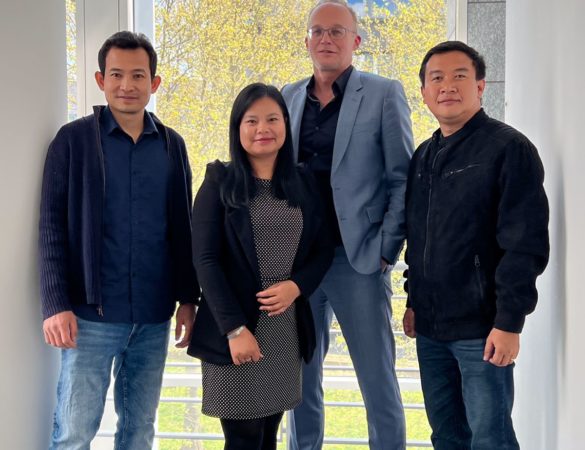
The University of Luxembourg welcomed three Lao lecturers from the Faculty of Law and Political Science of the National University of Laos for a two-month research stay in March and April 2022. Mr. Latdavanh Donkeodavong, Mr. Phanthasack Mingnakone and Ms. Boualaphiane Sisouk could finally travel to Luxembourg after the easing of travel restrictions to make the most of the research facilities of our University.
The three lecturers were selected at the end of 2019 by the University of Luxembourg following a public call for applications requiring a research proposal, a cover letter and a CV and an interview. The selection was based on the quality of their research proposal, their level of English and the coherence of the motivation for applying.

The Inter-University Cooperation Project is supporting three essential topics for the development of Lao PDR and the strengthening of the Rule of law: Mr Donkeodavong is working on State Compensation Law, looking at comparative perspectives from Germany and France; Mr Mingnakone is investigating the legal framework on pre-trial detention and the right to a fair trial in Lao Criminal Law Procedure; Ms. Boualaphiane Sisouk is examining the legal framework on the implementation of international treaties in Lao PDR.

During their research stay, the lecturers had the chance to present their intended research to Law Professors and PhD students during an event organised by Doctoral School of Law at Kirchberg Campus. They also received guidance from Professor Stefan Braum (Project leader) and met regularly with PhD candidates. They were allowed full access to academic resources and enjoyed in particular the facilities of the Learning Centre at Belval campus.
Back in Laos, they are now continuing their research under the supervision of Dr Perrine Simon, (Liaison Officer) and are expected to complete it before the end of 2022 for a publication in a law journal in English.

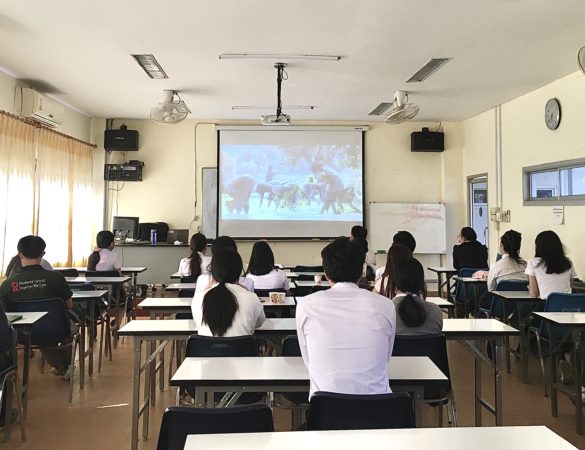
In the framework of the Inter-University Cooperation Project Laos-Luxembourg, the University of Luxembourg organised its first law movie club on the 30th of March 2022.  The objective is to broaden students’ legal knowledge and cinema culture in a fun and enjoyable way. The students will have the chance to learn more about international justice and other legal systems. Most of the movies we plan to screen will be in English, so that the students can improve their English skills and develop their legal vocab.

The movie screening was organised in partnership with the Ms Khonesavanh Vongvanhnaxay, Human rights law lecturer and attended by 21 students and from the Faculty of Law and Political Science, International Relations Department.

For our first session, we screened the movie “First They Killed My Father” directed by Angelina Jolie released in 2017 on Netflix, which received several awards. The movie is based on the true story of Luong Ung and on her book published in 2000. The film portrays her heart-breaking family story in the labour camps in Cambodia and her enrolment as child soldier under the Khmer Rouge regime in the 1970s.  

At the end of the session, the Project intern Ms Maynika Phongsa ran a Kahoot quiz prepared with Dr Perrine Simon testing the students’ knowledge on International criminal law, relating the movie to the ICL offences of “genocide”, “crime against humanity” and “war crime” and the Extraordinary Chambers in the Courts of Cambodia.  The winner of the quiz Ms Soutlasi Yarkaomany was rewarded with one of our personalised Project bags!  

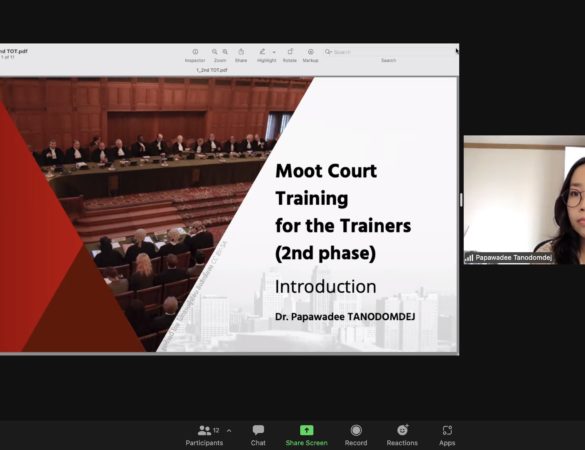
The University of Luxembourg is actively supporting problem-based learning (PBL) through training for lao lecturers to lead them on the path to be a “Moot coach”. Following the success of our first ‘train-the trainer’ moot court in November 2021, lao lecturers were eager to deepen their mooting skills and solicited a follow-up training with Dr. Papawadee Tanodomdej from Chulalongkorn University (CU). Dr. Tanodomdej is a lecturer of Public international law, the coach for Chulalongkorn’s team in the Philips C. Jessup International Moot Court Competition 2021 and is also actively involved in the Thailand IHL Moot Court Competition organised by the ICRC.

The training, which took online place from the 1st  to the 24th of March, 2022, was attended by around 15 lecturers from the FLP of NUOL and from the Faculty of Law and Administration, of the University of Champasak

The main objectives of this follow-up training were to build understanding on IHL and ICL (International Criminal Law) legal issues and pleading skills to prepare the lecturers in moot court coaching. The training was run in Thai language and divided into 4 sessions. The first session covered specific selected legal issues (one count of a previous moot problem) and the sources of law/ research material. The second session covered the jurisdiction of the ICC and how jurisdiction apply to actual cases before the ICC. The third session dealt with the “war crime of compelling a prisoner of war or other protected person to serve in the forces of a hostile Power” and the constitutive elements of this offence, as well as with individual criminal responsibility. The lecturers  were divided into two teams to work together and prepare their pleading as the defendant and prosecutor for the last session during which they practiced real pleading

During the training, participants also had the opportunity to work in teams in break-out rooms and had research “homework” to do to prepare the pleading. This practical aspect of the training helped the participants to gain in-depth understanding on how moot court pleadings work. Dr. Papawadee also shared her experience as a coach in Thailand and on how to make good pleading.

The training was particularly fruitful and constitutes a step forward the strengthening of moot court collaboration with Thai Universities. The Inter-University Project plans to scale up cooperation with Thailand by organizing a joint Moot court in Thai language focusing on a simpler moot case of International Criminal Law, bringing the new Lao coaches on board with a few Lao teams of students. This could be hosted either by Thammasat or Chulalongkorn University in Bangkok during spring 2023.